A Premium Aluminum Entry Door can make a home’s entrance feel brighter, stronger, and more contemporary. Its slim frame may let daylight reach a hallway, while a textured finish can add warmth beside brick or stone. Yet appearance is only part of the decision. Glazing, hardware, thermal performance, and installation all affect how a door works over time. Small details matter.
This guide explores ten common types, from minimalist flush designs to doors with glass panels, sidelights, or decorative patterns. Each option suits different priorities. A large glazed entry can open a dim foyer to sunlight, while a solid panel may offer a more private look. Thermal breaks and suitable seals can also influence comfort, but performance varies by product and installation. Check the manufacturer’s specifications rather than relying on appearance alone.
There is no single best style for every home. A door that looks elegant in a showroom may feel out of place beside a traditional façade. That is easy to overlook. Consider your home’s architecture, local climate, maintenance expectations, and the space available for the swing. Ask installers how the frame will be anchored and sealed; even a well-made door can disappoint if fitted poorly. The comparisons ahead are a useful starting point, not a substitute for checking dimensions and product details. Some choices are less obvious than they seem.
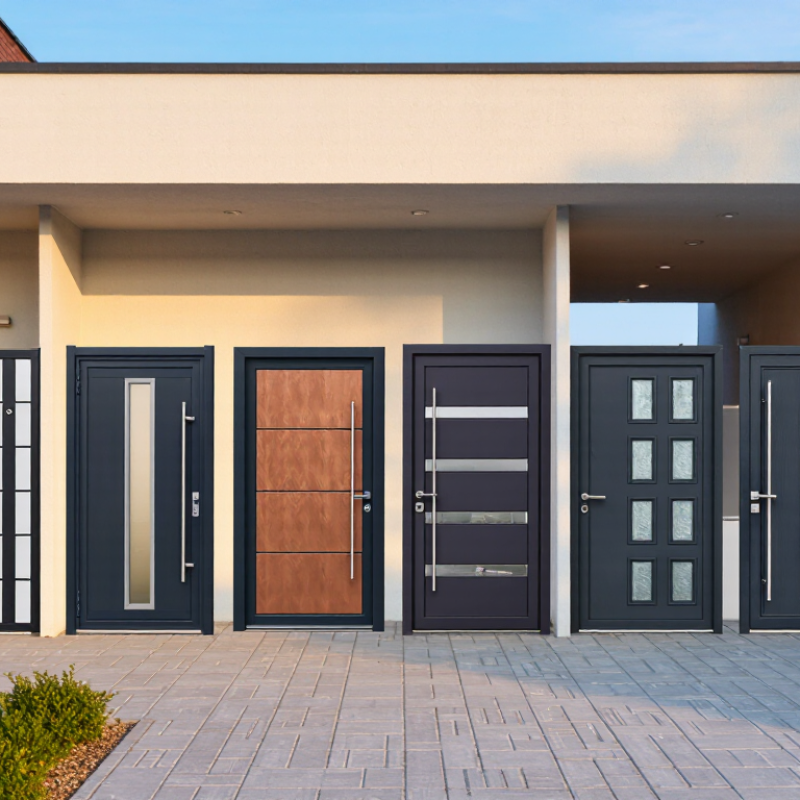
A premium aluminum entry door is defined by measured performance, not a heavy-looking frame or a glossy finish. Its frame should resist bending, while a thermal break separates interior and exterior aluminum to reduce heat transfer. Look for tight corner joints, continuous weather seals, and a sill designed to drain water outward. Small details matter. A beautiful door can still leak air if its seals are poorly fitted.
For glazed panels, check the National Fenestration Rating Council (NFRC) label for U-factor and solar heat gain coefficient (SHGC). These ratings let buyers compare products using consistent measures rather than vague efficiency claims. The U.S. Department of Energy’s Energy Saver guidance estimates that heat gain and loss through residential windows account for 25–30% of home heating and cooling energy use. That figure applies to windows, not entry doors alone, but it makes glass area and rating worth checking.
Air and water performance also deserve attention. The North American Fenestration Standard (NAFS) classifies products through tested air leakage, water penetration, and structural performance. Ask for the door’s test results and confirm they match your exposure, especially on windy or rain-prone elevations. A higher price is not proof of better performance. Installation can still undermine a well-tested door. Repairability is easy to overlook, too. A replaceable seal may matter more after years of use than a flawless showroom finish.
Aluminum entry doors are shaped as much by their visible details as by their material. Frame width, panel layout, glazing, and opening style determine how a door looks and works. A flush design has a smooth, minimal face, while a paneled version adds depth through raised or recessed sections. Slim-frame doors maximize glass, but narrow profiles can feel stark beside a traditional facade. Small details matter.
Large glazed doors bring daylight into an entry, though privacy and afternoon heat deserve attention. Frosted or textured glass softens views without making the doorway feel closed. Pivot doors rotate on floor-mounted hardware and create a bold, wide opening; their weight and clearance need careful planning. Sliding doors save swing space, but their tracks must be kept clean to move smoothly. French-style pairs offer symmetry, while a single hinged door usually needs less clearance.
Thermally broken frames use an insulating barrier between interior and exterior aluminum, which can help reduce heat transfer. A sound frame still depends on well-fitted weather seals, suitable glass, and a properly installed threshold. Color and finish also change the impression: matte dark surfaces look crisp, while lighter tones can make a compact entrance feel less heavy. The trade-offs are easy to miss. I would compare the door’s proportions with the actual entry, not just a showroom sample.
Premium aluminum entry doors vary by configuration, not just finish. A single hinged door suits compact porches and gives a clean, familiar entry. Double doors create a wider opening for moving furniture, but both leaves need room to swing. Pivot doors rotate on floor and ceiling hardware, making a large panel feel surprisingly light. They also need careful clearance planning. Sidelights add narrow glazed panels beside the door, while a transom brings daylight above it. These options can be combined, though more glass may reduce privacy.
Tips: Measure the finished opening, including flooring and trim. Check the swing path against steps, walls, and nearby furniture. Ask how the frame handles thermal movement and water drainage; details vary by system.
Configuration affects daily use more than a showroom photo suggests. A pivot panel may look striking, yet wind or an uneven floor can make operation less convenient. Double doors can feel generous, but one leaf may become the regular route in and out. Review the threshold height, handle position, and glazing sightlines with the installer. Small details are easy to overlook—and occasionally, the first plan needs revising.
Premium aluminum entry doors come in hinged, pivot, double, and glass-panel designs. Their appearance matters, but performance depends on the frame, glazing, seals, and installation. For security, inspect lock reinforcement, hinge fasteners, and frame anchoring—not just the number of locking points. A narrow, well-fitted door can feel more secure than a heavier door with weak installation. Ask for documented test results where available. Specifications vary.
Tips: Compare whole-door U-factor and air-leakage ratings, not glass claims alone. In cold or hot climates, thermal breaks reduce heat transfer through aluminum. Check weatherstripping for continuous contact, and inspect the threshold for a tight seal. For durability, ask about finish warranties, drainage paths, and hardware corrosion resistance. Small details matter.
Match the configuration to the entryway. Double doors offer a broad opening, while sidelights add daylight but increase glazed area. Consider laminated or tested impact-resistant glazing if security or storm exposure is a concern, and confirm the complete assembly is rated accordingly. Comparison sheets are useful, though they can hide trade-offs. I would prioritize verified performance and careful installation over a dramatic finish.
Comparison is indicative, not a product rating. Performance depends on the complete door assembly, including frame, glass, locks, weather seals, installation, and applicable local standards. Several types below are features or configurations that can be combined.
| Door Type | Typical Construction | Security Potential | Thermal Efficiency | Durability Considerations | Best Comparison Check |
|---|---|---|---|---|---|
| 1. Thermally Broken Hinged Door | Hinged aluminum frame with a non-metallic thermal barrier separating interior and exterior aluminum sections. | Moderate to high when paired with a reinforced frame, suitable hinges, and a quality lock; the thermal break itself is not a security feature. | Generally better than a comparable non-thermally broken aluminum door because the barrier reduces heat transfer through the frame. | Aluminum resists corrosion, while seals and finishes need periodic inspection and care. | Check documented whole-door U-factor or U-value, air-leakage data, frame reinforcement, and lock specification. |
| 2. Insulated Panel Hinged Door | Aluminum door skins or faces surrounding an insulated core, commonly used for a more private, opaque entrance. | Can offer good resistance when the panel, lock area, frame, and hinges are reinforced as a complete assembly. | Often better than a largely glazed design, but results vary with panel thickness, core, frame, and perimeter seals. | Inspect panel edges, joints, finish quality, and drainage details to reduce the risk of moisture-related deterioration. | Ask for panel composition, whole-door thermal data, and details of reinforcement around the lock and hinges. |
| 3. Aluminum Door with Insulated Glass | Aluminum frame with a sealed insulating-glass unit, typically using two panes separated by a spacer. | Depends strongly on the glazing and hardware. Standard insulating glass is not automatically resistant to forced entry. | Usually more efficient than single glazing; low-emissivity coatings and gas-filled units may improve performance when properly specified. | Sealed glass units can lose insulating performance if their perimeter seals fail; check warranty and replacement options. | Compare whole-door thermal ratings, glass make-up, safety-glazing requirements, and the glazing-retention method. |
| 4. Laminated-Glass Aluminum Door | Glazing made with glass layers bonded to an interlayer; the glass may remain held together when cracked. | Can delay passage after breakage compared with ordinary monolithic glass, but resistance varies by glass build-up and frame retention. | Thermal performance comes from the complete glazing and frame system, not from lamination alone. | Choose glazing suitable for the exposure and confirm that the frame and seals are compatible with the glass unit. | Verify the exact glass build-up, safety-glazing certification, and any tested forced-entry rating for the complete assembly. |
| 5. Tempered-Glass Aluminum Door | Uses heat-treated safety glass designed to break into smaller fragments than ordinary annealed glass. | Tempered glass is a safety-glazing choice, not a security-glazing equivalent; it may break more readily than laminated constructions. | Depends on whether the door uses single glazing or an insulating-glass unit and on the frame design. | Heat treatment improves resistance to thermal stress and impact compared with annealed glass, but the glass can still break. | Check required safety-glazing locations, glass configuration, and whether security performance is separately tested. |
| 6. Multi-Point-Locking Hinged Door | Hinged door with a lock mechanism that secures the leaf at multiple points along the frame when operated. | May improve resistance to spreading at the lock side when correctly installed with a strong frame and compatible strike plates. | Multiple engagement points can help draw the door against its seals, but they do not guarantee airtightness. | Moving parts require correct adjustment and occasional maintenance to keep the door closing smoothly. | Compare lock testing or certification, cylinder protection, frame reinforcement, and the number and placement of locking points. |
| 7. Reinforced Outswing Door | Hinged door that opens outward, often selected where interior clearance is limited or wind exposure is a concern. | Can be secure with protected hinge pins or security hinges, a reinforced frame, and an appropriate lock; exposed hinges need attention. | Performance depends on the threshold, compression seals, frame, and installation. Opening direction alone does not determine efficiency. | Weather exposure and wind loads make hinge, threshold, drainage, and seal quality particularly important. | Check hinge security, wind-load suitability, water-management details, and the door’s tested air and water performance. |
| 8. Pivot Aluminum Entry Door | A large or distinctive leaf that rotates on pivot hardware rather than conventional side hinges. | Varies widely; pivot hardware, locking points, frame anchoring, and the gap around the leaf all affect resistance. | Large leaves and unusual perimeter gaps can make sealing more challenging; verified whole-door test data is important. | Hardware must be correctly sized for door weight and adjusted over time; large panels can be more demanding to handle. | Confirm maximum tested leaf size and weight, pivot capacity, locking arrangement, threshold details, and thermal data. |
| 9. Double-Leaf Aluminum Entry Door | Two hinged leaves, usually with one active leaf and one secured inactive leaf. | Security depends on locking both leaves, securing flush bolts on the inactive leaf, and reinforcing the meeting stile. | The center meeting joint adds another sealing area, so air and water performance depends on careful design and installation. | More hardware and a wider opening require regular checks of alignment, flush bolts, seals, and thresholds. | Inspect the inactive-leaf locking method, meeting-stile overlap, overall tested performance, and installation requirements. |
| 10. Aluminum-Framed Sliding Entry Door | One or more panels move horizontally on tracks; often chosen for wide openings and indoor-outdoor access. | Can be secure with suitable locking hardware, anti-lift features, and robust glazing retention; track and panel design matter. | Thermal breaks, insulated glass, interlocks, and weather seals can improve performance, but sliding seals differ from hinged compression seals. | Tracks and rollers need cleaning and maintenance; debris or wear can affect operation and sealing. | Compare the complete system’s security testing, anti-lift design, air and water ratings, glass specification, and roller serviceability. |
Choosing among premium aluminum entry doors starts with your climate, doorway size, and daily use. Thermal-break frames reduce heat transfer through the metal. Insulated-panel doors suit exposed, colder entrances, while flush designs create a simple, solid look. Glazed models brighten a dim hall; sidelights add more daylight but need careful placement for privacy. Pivot doors make a dramatic entrance, though they require enough clearance.
Check the details, not just the finish. The U.S. Department of Energy estimates that heat gain and loss through windows account for 25–30% of residential heating and cooling energy use. That figure is not specific to doors, but it matters when comparing doors with large glass areas. Review the NFRC label for U-factor and solar heat gain coefficient, then compare the figures for your climate. A powder-coated surface can resist weathering, but scratches may still show. Even a beautiful door can feel disappointing if its threshold lets in drafts.
Tips: Measure the rough opening, including the sill, before ordering. Check the swing against nearby walls and furniture. In sunny exposures, ask about glass coatings and shading. Small detail. Also inspect seals and hardware in person; glossy showroom samples rarely reveal how a latch feels after repeated use.
Compare representative door configurations by the number of movable door leaves. Consider your available space, desired opening width, and how you use the entry when choosing a style.
These are example configurations, not market rankings or performance scores. Counts show movable door leaves; fixed sidelights are not included.
A single hinged door needs less space and offers a familiar route indoors. Double doors create a wider opening but need room to swing. Details matter.
Pivot doors make large panels feel lighter, but they need careful clearance planning. Check nearby steps, walls, and furniture. An uneven floor may affect operation.
Sidelights add daylight beside the door, while a transom brings light above it. More glass can reduce privacy, so check sightlines from outside.
Inspect lock reinforcement, hinge fasteners, and frame anchoring. Ask for documented test results when available. Installation matters more than a heavy-looking panel.
Compare the whole door’s U-factor and air-leakage rating. Thermal breaks can reduce heat transfer through aluminum. Glass figures alone do not describe the complete door.
Measure the finished opening, including flooring, trim, and the sill. Check the swing path against nearby walls and furniture. I might rethink that choice.
Ask about finish warranties, drainage paths, and hardware corrosion resistance. Check that weatherstripping touches continuously and the threshold seals tightly. Scratches may still show.
It can brighten a dim hall, but consider privacy, glass coatings, and shading. Window heat gain figures are not specific to doors. Check the details.
A Premium Aluminum Entry Door combines a strong, lightweight frame with refined design and dependable performance. Its defining qualities include solid construction, quality finishes, thoughtfully engineered hardware, and options that support comfort and security. Appearance can vary through frame profiles, colors, glazing, panel details, and opening styles, allowing the door to complement different homes while meeting practical needs.
Premium aluminum entry doors come in configurations such as single, double, glazed, solid-panel, pivot, and sidelighted designs. When comparing options, consider how the door’s construction, seals, glazing, and locking hardware affect security, energy efficiency, and long-term durability. The right choice depends on your entrance dimensions, local climate, desired level of natural light, maintenance preferences, and architectural style. Balancing these factors helps you select a door that looks cohesive, performs reliably, and suits everyday use.

ShieldCraft Doors