10 Tips for Choosing a Modern Aluminum Entry Door

Time:2026-10-28 Author:Liam
0%

Choosing a Modern Aluminum Entry Door is not only a style decision. It affects security, insulation, daylight, maintenance, and the first impression of your home. The right door should feel calm when it closes, resist weather at the threshold, and remain attractive after years of daily use.

David Adjaye, an internationally respected architect, has said, “Architecture is a social act and the material theater of human activity.” His idea applies directly to an entry door. This small architectural element welcomes guests, separates private life from the street, and communicates how a home is cared for. A carefully selected aluminum door can support that experience through clean lines, narrow sightlines, durable finishes, and precise hardware.

Yet appearance can distract buyers. I have seen homeowners choose dramatic black panels without checking thermal performance or drainage details. It looked impressive in a showroom. It felt less successful beside a windy, shaded entrance. That mistake is easy to repeat.

These ten practical tips examine frame quality, glazing, insulation, opening direction, locking systems, finish durability, accessibility, installation, and long-term care. They also question popular assumptions. Bigger glass is not always better. Minimal hardware is not always easier to use. A premium price does not automatically prove premium construction.

Measure the opening carefully. Ask for documented performance data. Examine samples in natural light. Then consider how the door will feel on an ordinary rainy morning, not only how it photographs today.
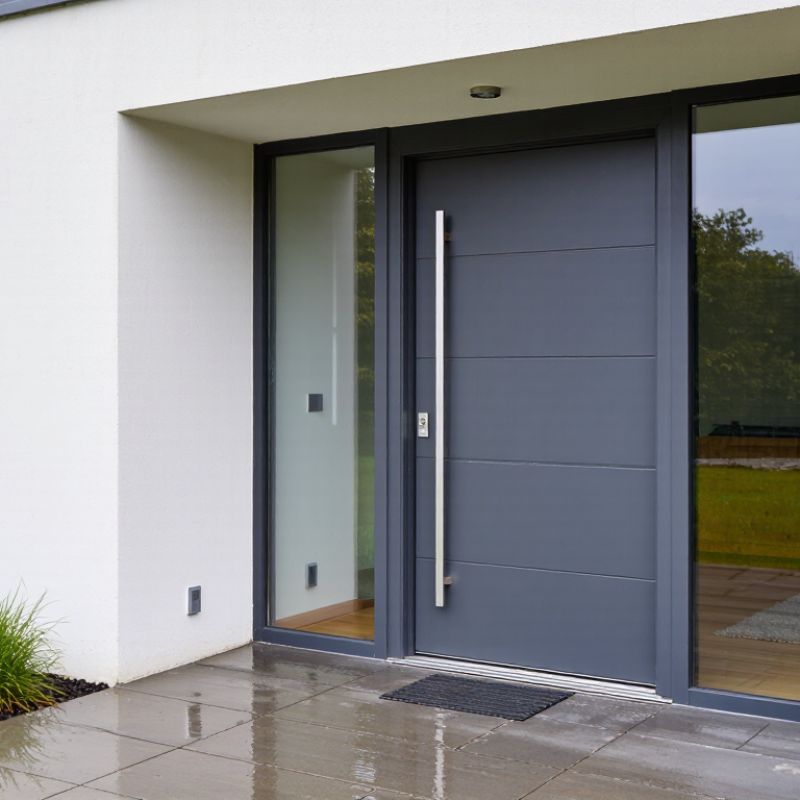
10 Tips for Choosing a Modern Aluminum Entry Door

Define Entry-Door Needs with NFRC U-Factor and SHGC Ratings

Choosing a modern aluminum entry door starts with the opening’s real performance needs, not its finish. Read the NFRC label before comparing handles, colors, or decorative glass. The U-factor measures heat flow through the complete door assembly. Lower numbers generally mean better insulation and less indoor heat loss. Look for the climate-appropriate value, not simply the lowest advertised figure. Cold regions benefit from reduced heat loss.

SHGC shows how much solar energy enters through the glazed portion. A lower SHGC can reduce afternoon heat near a west-facing entrance. In colder, sunny climates, a moderate or higher SHGC may provide useful warmth. Direction matters. A north-facing door usually receives less direct sun than a south- or west-facing one. Ask whether the rating covers glass, frame, and spacers together. That detail is easy to miss.

For aluminum, thermal breaks deserve close attention because metal conducts heat quickly. Also inspect weatherstripping, sill design, and installation tolerances. Even an excellent rating can disappoint when air leaks around the frame. Use local energy requirements as a baseline, then discuss comfort with a qualified installer. Request the exact NFRC values in writing. Do not rely on vague claims such as energy efficient. A small foyer may feel cold because of leakage, not poor glass performance. I would recheck the decision after observing the doorway through one full season.

Compare Thermal Breaks and Verify AAMA/WDMA/CSA 101 Performance

10 Tips for Choosing a Modern Aluminum Entry Door

A thermal break separates the interior and exterior aluminum with a low-conductivity barrier. It reduces heat transfer through the frame. Do not judge it by appearance alone. Ask for a cross-section, frame U-factor, and condensation-resistance data. Compare the complete door assembly, including glass, threshold, hardware, and weatherstripping. A narrow frame may still perform poorly. Check how the door suits your climate and exposure. Cold regions need strong resistance to interior condensation. Hot climates also benefit from reduced heat gain. Look for insulated glazing and carefully sealed joints. Small gaps matter.

Request test documentation to AAMA/WDMA/CSA 101, using the current applicable edition. Verify the performance class, grade, tested size, glazing type, and configuration. The report should match the exact door, not a similar model. Review air leakage, water penetration, structural pressure, and operating-force results. Ask how the sill drains water after heavy rain. Check the threshold height against accessibility needs and local requirements. Confirm installation instructions, because field errors can defeat laboratory performance. Inspect corner joints and seals before delivery. Keep the paperwork.

I have seen attractive doors fail because installers skipped sill flashing. That mistake is easy to repeat. A perfect specification cannot rescue poor installation. One detail is often overlooked: thermal breaks do not stop every cold bridge around locks and fasteners. Ask about those areas. If a supplier avoids specific test evidence, pause before ordering. The cheapest comparison is rarely the most useful one.

Evaluate Aluminum Finishes Using AAMA 2603, 2604, and 2605 Standards

When comparing modern aluminum entry doors, treat finish specifications as evidence, not decoration. AAMA 2603, 2604, and 2605 define rising levels of organic-coating performance. AAMA 2603 covers basic coating requirements for sheltered entrances. AAMA 2604 adds stricter durability controls and a five-year South Florida weathering test. AAMA 2605 represents the highest tier, including a ten-year South Florida exposure test. These periods describe testing, not guaranteed service life. That difference matters. Salt spray, standing water, and abrasive dust can still accelerate surface aging.

During field inspections, I check the written compliance claim, coating thickness, gloss, color, and exposed cut edges. Ask for the exact AAMA standard, test method, and certificate date. “Premium finish” proves little. The U.S. Department of Energy’s Energy Saver guidance estimates that windows and doors can represent up to 25%–30% of household heating and cooling energy use. That figure concerns the complete assembly, not the coating alone. A durable finish cannot correct poor weatherstripping or a weak thermal break. I would also question a 2605 claim on a low-cost door without supporting documentation. It may be legitimate. It may not. Coastal projects deserve extra caution, because laboratory exposure cannot reproduce every local condition.

10 Tips for Choosing a Modern Aluminum Entry Door - Evaluate Aluminum Finishes Using AAMA 2603, 2604, and 2605 Standards

Tip Selection Area What to Evaluate Relevant AAMA Finish Standard Practical Selection Guidance Questions to Ask Before Ordering
1 Define the Exposure Identify direct sunlight, coastal salt air, high humidity, industrial pollutants, wind-blown sand, and frequent rainfall at the installation location. AAMA 2603, 2604, and 2605 are performance specifications for organic coatings applied to aluminum extrusions and panels. The appropriate level depends on environmental exposure. Use a higher-performance coating when the door is strongly exposed to sunlight, moisture, salt, or abrasive airborne particles. Do not select a finish by color alone. Is the proposed finish tested and documented for the intended exposure? Is the door sheltered, partially exposed, or fully exposed?
2 Compare AAMA 2603, 2604, and 2605 Review coating type, film performance, color retention, chalk resistance, gloss retention, adhesion, humidity resistance, and salt-spray performance. AAMA 2603: standard organic coating performance for less demanding applications.
AAMA 2604: high-performance coating specification with more demanding durability requirements.
AAMA 2605: superior-performance specification for the most demanding architectural applications.
For a prominent exterior entry door, AAMA 2604 is commonly considered a stronger baseline than AAMA 2603. AAMA 2605 is the most conservative choice where long-term appearance retention is a priority. Which exact AAMA specification applies to the finish? Is the claim supported by a current technical data sheet or certification documentation?
3 Check Color Retention Examine resistance to fading and color shift, especially for dark, saturated, or metallic colors exposed to strong ultraviolet radiation. AAMA 2604 and AAMA 2605 include stricter appearance-retention requirements than AAMA 2603. The applicable limits depend on the edition and test method used. Request measured color-change data rather than relying on a showroom sample. Dark finishes can absorb more solar heat and may show visual change more readily. What color-change limit was recorded after the required weathering exposure? Was the test performed on the same coating system and color family?
4 Evaluate Chalk Resistance Chalking is a powdery surface degradation caused by weathering. Inspect the expected chalk-resistance classification and exposure results. AAMA 2605 generally requires tighter chalk-resistance performance than AAMA 2604, while AAMA 2603 is intended for less demanding durability needs. Choose a finish with documented chalk resistance when the door is highly visible or receives prolonged direct sun. Keep the specification and test report with the project records. What chalk rating and exposure duration apply to this finish? Is the rating based on the current AAMA specification edition?
5 Review Gloss Level Compare gloss consistency, reflectivity, surface texture, and how easily fingerprints, dust, water marks, and minor scratches may be noticed. All three AAMA specifications address coating performance, but the selected gloss level must also be matched to the coating manufacturer's documented test data. Low- or medium-gloss finishes can visually disguise minor surface marks better than high-gloss finishes. Use a physical sample viewed in outdoor light. What is the measured gloss range? Will the visible door surfaces, trim, and adjacent panels use the same gloss and texture?
6 Verify Corrosion Protection Assess resistance to humidity, salt spray, filiform corrosion, and corrosion originating at cut edges, fasteners, joints, or damaged areas. AAMA 2604 and 2605 provide more demanding corrosion-resistance requirements than AAMA 2603. Test results apply to defined laboratory conditions and do not eliminate installation risks. For coastal or high-humidity locations, prioritize a documented high- or superior-performance coating and compatible corrosion-resistant hardware. Does the coating system include pretreatment suitable for aluminum? How are cut edges, drainage points, and dissimilar-metal contacts protected?
7 Inspect Surface Preparation Look for uniform pretreatment, complete coverage, clean corners, consistent film thickness, and freedom from pinholes, blisters, runs, or visible contamination. AAMA finish specifications depend on proper substrate preparation and coating application. A label alone cannot correct poor pretreatment or inadequate film application. Inspect the actual door or an approved production sample under neutral lighting before installation. Confirm that touch-up procedures are documented. What pretreatment process is used? How is dry-film thickness checked, and what inspection criteria are applied before shipment?
8 Balance Thermal Performance Evaluate thermal breaks, insulated cores or glazing, weatherstripping, threshold design, air leakage, and whole-door energy performance. AAMA 2603, 2604, and 2605 address coating performance, not the door's complete thermal or air-leakage rating. Select a thermally improved door system when indoor comfort and energy use matter. Compare whole-door performance, not coating grade, for thermal decisions. Is a tested whole-door U-factor or U-value available? Does the door have a thermal break and a tested air-leakage rating?
9 Match Hardware and Glazing Confirm compatibility among hinges, locks, handles, glass, gaskets, sealants, fasteners, and the selected aluminum finish. AAMA coating compliance does not automatically establish the corrosion resistance, security, impact performance, or weather performance of hardware and glazing. Use hardware rated for the local environment and avoid direct contact between incompatible metals without suitable isolation. Are hardware and sealants compatible with the finish? Are glass, lock, hinge, and weather-performance ratings documented separately?
10 Plan Cleaning and Inspection Establish a routine for removing dirt, salt, and pollutants; checking drainage; and documenting scratches, coating damage, sealant failure, or corrosion. AAMA specifications define laboratory performance requirements, while regular maintenance helps preserve the installed finish and may be required by project documentation. Use clean water and a mild, non-abrasive cleaner; rinse thoroughly and dry with a soft cloth. Avoid abrasive pads, strong solvents, and unapproved chemicals. What cleaning frequency is recommended for this exposure? Which cleaners and touch-up materials are approved for the specific coating?
Important comparison note: AAMA 2603, AAMA 2604, and AAMA 2605 are coating-performance specifications, not complete entry-door product ratings. Verify the current specification edition, coating system, substrate preparation, test documentation, warranty terms, thermal performance, air leakage, water resistance, hardware compatibility, and installation requirements separately.

Check Security Hardware Against ANSI/BHMA Grade Requirements

A modern aluminum entry door can look light, but its security hardware must handle daily force. Check the lockset, cylinder, hinges, and strike plate against the correct ANSI/BHMA standard. The grade should match the hardware type, not just the door’s appearance.

Grade 1 hardware generally offers stronger performance for demanding entrances, while Grade 2 may suit many residential applications. Confirm the product’s exact listing and test documentation. Do not rely on a package label alone. Ask whether the deadbolt meets the relevant ANSI/BHMA requirements and whether the cylinder resists common forms of forced manipulation. Small details matter. A long, reinforced strike plate needs solid screws that reach the structural framing, not only the aluminum skin.

The door frame also deserves inspection. Misalignment can prevent the bolt from extending fully, even with certified hardware. Check the hinge side for movement, exposed fasteners, and weak mounting points. A professional installer should verify clearances after the door is hung. This is where plans sometimes fail. A premium lock cannot correct a flexible frame or poor installation. I also recommend recording the hardware grade, standard number, and installation date. That record makes future maintenance clearer. Security decisions are rarely perfect, and higher grade does not automatically mean better protection in every doorway. Context still matters.

10 Tips for Choosing a Modern Aluminum Entry Door

Security hardware should be checked against the applicable ANSI/BHMA grade. For bored and cylindrical locksets covered by ANSI/BHMA A156.2, higher grades indicate greater durability and performance requirements.

ANSI/BHMA A156.2 durability benchmarks shown: Grade 1—800,000 cycles, Grade 2—400,000 cycles, and Grade 3—200,000 cycles. When selecting an aluminum entry door, also verify deadbolt fit, strike-plate reinforcement, frame anchoring, corrosion resistance, and compatibility with the door system. Requirements can vary by hardware category, so confirm the current standard for the specific product.

Confirm ADA Criteria: 32-Inch Clear Width and 5-Pound Opening Force

A modern aluminum entry door should be checked with a tape measure, not guessed from its nominal size. ADA access commonly requires at least 32 inches of clear opening width. Measure between the door face and the opposite stop with the door open about 90 degrees. A 36-inch door may not provide 32 inches of usable clearance after hinges, seals, and hardware are installed. Small details matter.

Opening force needs closer attention. For many interior, non-fire-rated doors, ADA guidance limits opening force to 5 pounds. Exterior entry doors may follow different requirements, so confirm the applicable local code and consult the authority having jurisdiction.

Test the finished door with a calibrated force gauge, if possible. Hand testing is useful, but unreliable. Weather seals can stiffen in cold conditions, while a closer can become harder to operate over time.

Keep the threshold low and stable. Avoid a sharp lip that catches wheels, canes, or shoes. Position the pull handle where a seated user can reach it without twisting. I have seen compliant clear width lost after thick weatherstripping was added. That mistake is easy to miss during installation. Recheck the opening after adjustment, not only before delivery. The ideal specification can still fail in real use.

FAQS

Which security hardware should be checked on an aluminum entry door?

Inspect the lockset, cylinder, hinges, and strike plate. Each item should match its appropriate ANSI/BHMA grade.

Is Grade 1 hardware always the best choice?

Not always. Grade 1 usually suits demanding entrances, while Grade 2 may fit many homes. Context still matters.

What should be verified beyond the package label?

Request the exact listing and test documentation. Confirm the deadbolt standard and cylinder resistance to common forced manipulation.

How should the strike plate be installed?

Use a long, reinforced strike plate with strong screws reaching structural framing. Screws fixed only into aluminum skin may be weak.

Can certified hardware fix a poor door frame?

No. Misalignment may stop the bolt from extending fully. Check hinge movement, exposed fasteners, and weak mounting points.

What should be recorded after installation?

Record the hardware grade, standard number, and installation date. This makes later maintenance clearer, though records can still be forgotten.

How is clear doorway width measured for accessible entry?

Open the door about 90 degrees. Measure the usable space between the door face and opposite stop.

Does a 36-inch door always provide 32 inches of clear width?

No. Hinges, seals, and hardware can reduce the opening. Measure the finished doorway, not its nominal size.

What opening force should be checked?

Many interior, non-fire-rated doors commonly use a 5-pound limit. Exterior doors may follow different rules, so confirm local requirements.

What small details affect real accessibility?

Keep the threshold low and stable. Avoid sharp lips. Recheck clearance after adding weatherstripping or adjusting the closer. Reality can disagree.

Conclusion

Choosing a Modern Aluminum Entry Door requires more than comparing appearance and price. Start by identifying your climate, energy goals, and daylight preferences, then use NFRC-rated U-factor and SHGC values to evaluate insulation and solar heat control. Examine the design of the thermal breaks, since they help reduce heat transfer through the frame. Performance claims should also be supported by appropriate AAMA, WDMA, and CSA 101 testing or certification.

Finish quality, security, and accessibility are equally important. Review whether the coating meets AAMA 2603, 2604, or 2605 requirements, depending on the expected durability and exposure conditions. Select locks, hinges, and other hardware that align with applicable ANSI/BHMA grade requirements, while confirming that the complete entry system provides practical protection and reliable operation. Finally, check accessibility details, including at least a 32-inch clear opening and an opening force of no more than 5 pounds, so the door is comfortable and usable for a wide range of occupants.

Liam

Liam

Liam is a dedicated marketing professional with a profound expertise in the industry, where he excels at highlighting the unique advantages of our core products. With a keen understanding of market trends and consumer needs, Liam frequently updates our company’s professional blog, providing......